The building is a form of body, which consists of lineaments and matter.
Leon Battista Alberti's De re aedificatoria ("On the Art of Building," in ten books) is the first architectural theory of the Renaissance — written in Latin, modeled on Vitruvius, and addressed not to builders but to the learned patron. Its opening move is decisive: the building is split into lineaments (design, born of thought) and matter (material, given by Nature). Design becomes a thing of the mind, governing construction. Book One then asks where to build — and turns out to be, above all, a meditation on health. Together with On Painting, the book belongs to a burst of new technologies of the eye and the project: perspective, the printing press, the opening of the world.
Leon Battista Alberti (1404–1472) was a Renaissance humanist educated in classics, mathematics, and law, who worked mainly as a papal administrator and scholar while simultaneously becoming the most influential architectural theorist of his age — as well as a writer, mathematician, urbanist, and cryptographer.
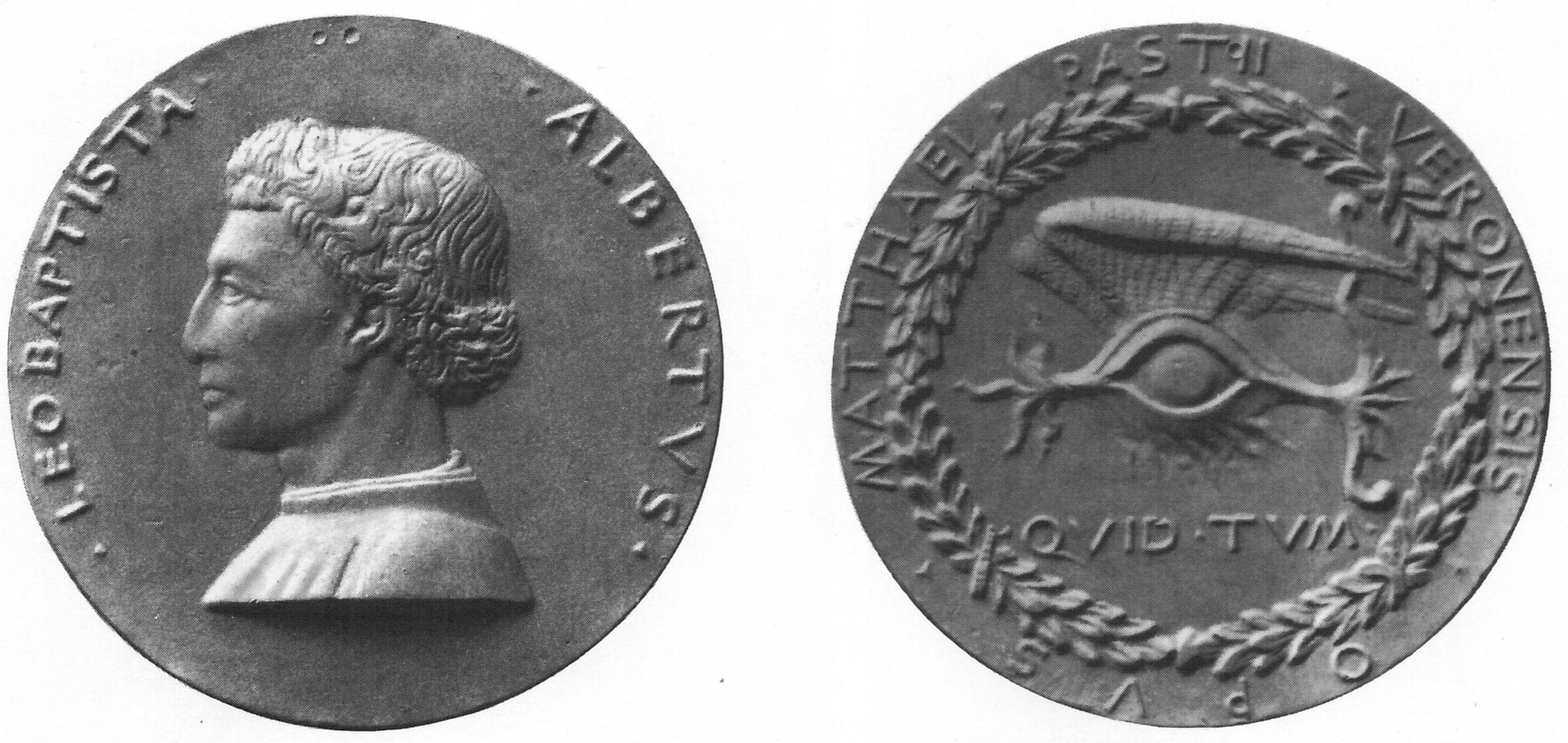
He gave himself an emblem: a winged eye, with the motto QVID·TVM — "What then?" / "So what?" The eye stands for vision, judgment, the all-seeing; the motto is half a shrug at his critics (and his illegitimate birth), half a Stoic what next? It appears on the bronze portrait medal struck by Matteo de' Pasti (c. 1446–50), and on his self-portrait plaquette — reckoned the earliest independent self-portrait in Western art.
Few but decisive — Alberti designed façades and churches that translated Roman antiquity into a new architectural language. The lineaments realised:

A Gothic church reclad as a Roman temple — the triumphal-arch façade, left unfinished.
wikipedia ↗
The first palace façade to grid a house with the superimposed classical orders.
wikipedia ↗
A marble façade tuned to whole-number proportion, with the great scroll-volutes.
wikipedia ↗
His masterpiece — a temple front fused with a triumphal arch over a vast barrel-vaulted nave.
wikipedia ↗_straight.JPG?width=700)
A radically centralised Greek-cross church raised on a podium.
wikipedia ↗A working life of treatises across nearly every field — moral philosophy and satire on one side, the technical arts and sciences on the other. The two technology books — On Painting and On the Art of Building — are marked ●. Linked titles open the digitised text in the Xenotheka library.
Alberti wrote the treatise in Latin between roughly 1443 and 1452, and showed a near-complete draft to Pope Nicholas V around 1452. He kept revising it until his death in 1472. It was first printed in Florence on 29 December 1485 — the first printed book on architecture, opening with a dedicatory letter from the humanist Angelo Poliziano to Lorenzo de' Medici.
For whom? In Latin, thick with classical citation, "worthy to live on the lips of the learned." The reader is the prince and the patron — those who commission and judge buildings — and the cultivated architect. Pointedly not the craftsman: "the carpenter is but an instrument in the hands of the architect."
Alberti's two great technical books — On Painting (1435) and On the Art of Building — are, in effect, technology books: manuals for new instruments of design. They sit inside a single generation that re-tooled how Europe saw and reached the world:
The conceptual engine of the book. A building "consists of lineaments and matter, the one the product of thought, the other of Nature." Neither suffices alone — you still need "the hand of the skilled workman to fashion the material according to lineaments."
The design. Product of thought, mind, reason. "The precise and correct outline, conceived in the mind, made up of lines and angles."
Immaterial — "it is quite possible to project whole forms in the mind without any recourse to the material." The same lineaments can recur in many buildings.
The material. Product of Nature, dependent on preparation and selection — stone, timber, brick.
Inert without design: it requires "the hand of the skilled workman to fashion the material according to lineaments."

In relation to Vitruvius — an inversion of order. Vitruvius opens De architectura by saying architecture "is born of fabrica and ratiocinatio" — of making and reasoning. He names fabrica first: the architecture grows up out of the craft, the continual practice of the hand, with reasoning second to explain and justify it. Alberti reverses the sequence. He begins from lineaments — pure thought, lines and angles held in the mind — and demotes matter and the workman's hand to an "instrument." Reason no longer follows making; it precedes and commands it.
Fabrica (making, the hand, continuous practice) comes first; ratiocinatio (reasoning) explains it after. Theory rises out of the craft.
Lineaments (thought) come first and rule; matter and the hand merely realise them. The intellect now governs the making.

This inversion is the birth, in theory, of the project — and of the architect as an intellectual rather than a master-builder. For a seminar on Raumgestaltung, it is the moment space becomes something you conceive before you build.
Two orders of making — the Vitruvian sequence, and Alberti's:
       FABRICA
   (making · craft)
          │
          │
       BUILDING
          │
          │
     RATIOCINATIO
      (reasoning)
          │
          │
 FIRMITAS · UTILITAS
     · VENUSTAS
LINEAMENT        MATTER
    │                │
    └───────┬────────┘
            │
         CORPUS
    (building body)
            │
       CONCINNITAS
            │
         BEAUTY
            │
        ORNAMENT
If lineaments are the building conceived in the mind, ornament is what the building puts on once it stands. Alberti draws the line carefully: beauty is innate — a reasoned harmony in which nothing can be added or taken away without loss — while ornament is added to it, fastened on. The column, the cornice, the opening, the revetment dignify a structure that utility has already made sound. Ornament comes last — and is never quite finished.
Ten sentences, in his own voice, where the word turns:
The thread through all ten: ornament serves — it completes beauty without replacing it, dignifies use without disguising it, and is measured less by the outlay of wealth than by the wealth of judgment.
Across the Prologue and Book One, six claims carry the weight:
And the practical scaffold — Book One names the six elements of building:
Most of Book One is, surprisingly, about health (salubritas). Choosing where to build is overwhelmingly a question of healthiness — and "health" works in two registers.
Pure, moving air is healthiest; stagnant air and water "absorb badness." Avoid marshes, valleys, south-facing coasts, sudden swings of hot and cold.
The ideal site is "moderately warm and moist" — temperate, elevated, "forever enlivened by some breath of wind."
Buildings exist partly to "keep us healthy": baths, walks, drains, ventilation — above all the roof, which "helps to maintain the good health of the residents."
The building has health like an organism; its life depends on roof, drainage and the circulation of air.
Alberti even lists the signs of a healthy site: an abundant harvest, inhabitants who reach "a ripe old age," "strong and handsome" youths, births "frequent and successful … not marred by any deformity." Deformed bodies, rust, leaning trees and eroded stone are read as symptoms of a sick climate.
Notions of a healthy location. What makes a place healthy changes radically from antiquity to the present:
The arc runs from health as found (read off the land) to health as produced (pumped through ducts). Alberti stands at the hinge: still reading the site like Vitruvius, but already turning a healthy location into a calculable matter of design.
Each age compresses its values into a triad. Read across, they tell a story — from the qualities of a building, to the rights of a citizen, to the comforts of a consumer.
Alberti's own triad is drawn straight from the text: every building "is born of necessity, nourished by convenience … and only in the end is pleasure provided for." Notice the drift over time — from qualities a thing should have (Vitruvius, Alberti) to rights a person should hold (1789) to conditions a service should deliver (today). What kind of values are "comfort, security, sustainability" — and who guarantees them?
A sharp reading exercise. The English translation reaches for modern political words — "nation," "Italy," "the state," "the republic" — to render a 15th-century Latin text whose concepts were quite different. These are the translator's terms; the modern meanings are anachronisms. Alberti thinks in Roman categories: the city (civitas) and the commonwealth (res publica), not the nation-state.

The city is like some large house, and the house is in turn like some small city.
The course reading, plus Alberti's works digitised in the ETH Xenotheka library:
Poliziano's foreword, the Prologue, and Book One.
open pdf ↗The complete architectural treatise, digitised.
xenotheka ↗The first treatise on linear perspective.
xenotheka ↗Measuring the body; enlarging a model by ratio.
xenotheka ↗A mathematical survey — the city plotted by coordinates.
xenotheka ↗Practical geometry, surveying, and the cipher.
xenotheka ↗A dark Latin satire on power, folly and grand designs.
xenotheka ↗