SilentWords
▌ Serres · Musique
As Aphrodite, born from foam and surf, rises from the chaotic sea of noise: music.
Serres, Musique 19–20 · the "music sum"
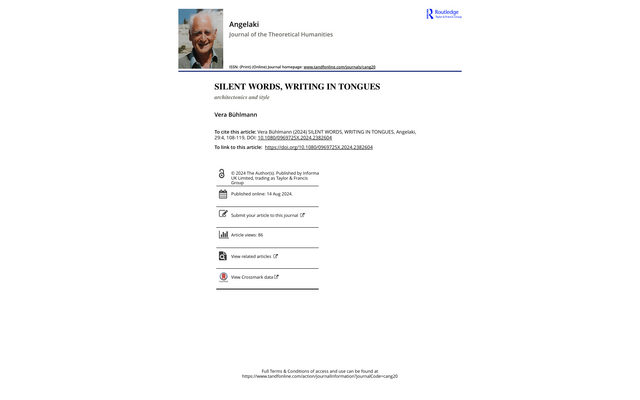
Vera Bühlmann's Silent Words, Writing in Tongues: Architectonics and Style (Angelaki, 2024) is really a text about why Michel Serres writes the way he writes — and what architecture, music, language, mathematics and philosophy all have in common. The central question is simple: how can writing communicate something deeper than explicit meaning? Her answer is that the most important part of language is often not what the words mean, but how they sound, resonate, connect and organize experience. She calls these the silent words: the parts of writing that can't be reduced to information or semantics. Writing, for Serres, is less about delivering a message than about building a dwelling for thought.
§01
Why he writes that way
Serres trained first as a mathematician, and only turned to philosophy later, after serving in the navy. One reason for the turn, Bühlmann reminds us, was the shock of the atomic bomb: it showed that scientific progress does not save us from violence and war. The bomb opened up a kind of power that seems to act from outside nature — and it draws its energy, literally, from light. Ever since, Serres has been writing to build what he calls a "physical culture": a way of thinking and living that could tame that power.
So for Serres, style is not decoration. It is the tool that lets thought pull away from dead ends and "come together with the formation of things." A physical culture is a culture of things that are self-sufficient — and self-sufficiency is something you have to tend and cultivate, like a plant you help to bloom, not something you grab by wanting to know it.
§02
Style over message — the Roman café
There's a story Serres tells about sitting in a café in Rome, surrounded by women chattering away. He barely follows the words. What he hears instead is the sound of the language — and to him it sounds like Scarlatti. Behind the meaning he catches "the scaffolding of this language, its tonal skeleton, its shrill music, its scarlet syntax."
Either you speak, without thinking, of the means of language, or you let it speak, sound, and sing of itself… The meaning emanates from the form.
— Serres, Musique 52
So there are two ways to communicate. Ordinary communication just transmits information: we use words and grammar without noticing them, and "we communicate — that's all." Artistic communication does the opposite — it lets the language itself sing, and brings the meaning out of the form. A nice detail follows from this: Serres says a writer really needs only two books, a guide to good usage and a dictionary — "that is one of the reasons my books have no bibliography."
Ordinary communication
Transmitting information. The message is foregrounded; the linguistic tools are forgotten. "We communicate — that's all."
Analytic. Meaning is broken out, encoded inside sentences.
Artistic communication
Letting language sing. The form is foregrounded; meaning is brought out, never broken out.
Synthetic. A "transcendental listening" to prosody, rhythm, the vibration of consonants and vowels.
§03
Music is the model
Underneath science, language and knowledge, Serres hears a deeper layer: noise, rhythm, resonance, harmony. He calls the way it all orders itself the "music sum" (musique-somme) — a kind of cosmic ordering that rises out of chaos, the way Aphrodite rises out of the sea foam. Music doesn't ask sense and meaning to be copies of itself; it simply "adds signals to noise."
And for Serres the first thing of all is not the word but rhythm. This is a point the short summaries tend to miss. Rhythm ties together two opposite movements — beating (steady, countable, repeating) and flowing (continuous, one-way) — into a single motion that keeps time. The whole universe turns this way too: galaxies, tides, weather, a spinning top, a waltz. "Make yourself a musician," Serres says, "in order to inhabit your body better."
In the beginning,
there is rhythm.
§04
Architectonics, not composition
The most important word in the paper is probably architectonics. Bühlmann borrows it from Mikhail Bakhtin (and, further back, from Lambert's Anlage zur Architectonic of 1771), who draws a careful line between composition and architectonics. The difference is sharper than just "technical vs. deep":
Architectonic form
Regards inner and bodily values, grasped as forms of nature. "They serve nothing, they are tranquilly sufficient unto themselves." Humor, character, type.
Compositional form
Has a "teleological, implemental, restless character," judged technically: how well did it fulfil its architectonic task? The devices, the arrangement.
Bakhtin warns that we tend to "dissolve architectonic forms in composition" — to shrink the deeper organization down to mere technique, and so to miss the quiet temperament that lives under any arrangement. That quiet temperament is the silent word. Architectonics is the hidden organization of relations and values beneath a text — just as a building has a hidden structure beneath what you actually see.
▌ Serres · on Leibniz
It constantly builds itself and speaks of itself; it intertwines its semantics and its syntax.
Serres, Système de Leibniz 3 · a system that describes its own formation
§05
What the summary missed
A few more threads carry a lot of the paper's weight and are easy to lose in a short summary. They're worth keeping, because this is exactly where Serres ties physics, ethics and writing together into one knot.
A
Ethics
The Natural Contract
"We have lost the world." Modern, a-cosmic philosophies hold forth only on language and logic while our actions pertain to physics. Real and rational are two incommensurate domains in a relation of equipollence; where the gap widens, pollution proliferates.
B
Device
The Static Tripod
In Statues, Oedipus and the Sphinx keep their lives in each other's hands by never reaching a conclusive point — adorning, inflating, deferring. The tripod / the chair / cosmos is a placeholder that holds the place of action. They talk at the risk of death.
C
Physics
Things Encode
"The atoms encode." Material elements perform as signs — they inform, elect, reflect, repel each other. Knowledge is the ability to listen to and translate the scattered languages of things. "They usually speak mathematics."
D
Time + Light
Materialist Poetics
Light is physics' one invariant: it clocks time (light speed) yet has a double nature — mass, colour, temperature on one side; timeless, mass-less photons on the other. A poetics of time as a cosmic marriage of Time and Light; the lapidary's diamond as "a star in the belly of the earth."
E
Luxuriation
Polytéleia
Not luxuria (excess, possession) but Greek polytéleia — many teloi tuned into one accommodating form. A positivism of luxuriation: inward formation and public service, a moderate thankfulness for the unlikeliness of being "here." Note: cosmos and cosmetics share a root.
F
Canonics
The Summa
Writing in tongues is closer to the medieval Summa than to "creative" writing. A treatise does not reveal a truth; it teaches how to tune intuition, how to handle and pick up what is already there — how to keep something "safe." Music and sculpture precede language: a transcendental silence.
§06
The Panonyme — a sixfold sheaf
One more figure worth carrying away. Serres has a name for the impersonal, "white" agency that can address the world only as a whole: its "proper name," the Panonyme. It comes in six parts — a quiet, precise picture of a universality that is no longer just "Man":
- Pantope — for all of its places.
- Panchrone — for all of its durations.
- Panurge — for the universal worker (the public worker — not demiurge).
- Panglosse — for all of the spoken tongues.
- Pangnose — for all of knowledge.
- Panthrope — for all sexes / all of humankind, in place of Anthropos.
"Writing in tongues" is really the practice of Panglosse: writing so that the many languages of things — mathematical, musical, material — can live together in one balanced form, without any single one of them taking over.
▌ Serres · Information and Thinking
They encode, we encode; they count, we count; we speak, they speak.
Serres, "Information and Thinking" 20
§07
Read the sources
§08
The author · ATTP
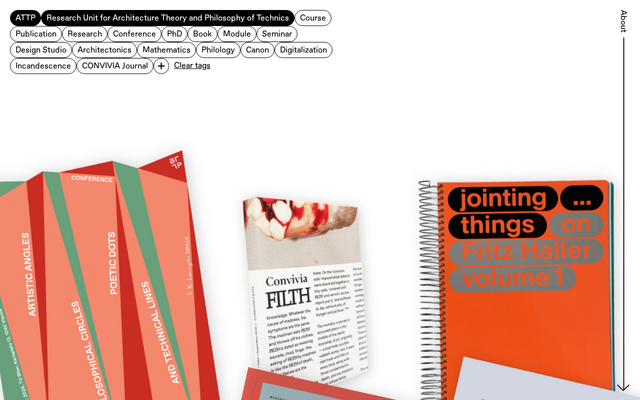
Vera Bühlmann directs ATTP — the Research Unit for Architecture Theory and Philosophy of Technics at TU Wien — where much of this Serres work lives. Three ways in:
§09
For your own work
This paper reads almost like a theoretical justification for the seminar's recurring claim: that texts, libraries, algorithms and architectures are all ways of articulating relations, not of transmitting fixed meanings.
- Alberti — the architect as the organizer of relations, not the builder of objects. Serres' "architectonics" is the same gesture, moved into language.
- Hovestadt — digital articulation, coding as literacy. Compare to Serres' "atoms encode / we encode": the world is "woven with disparate encodings."
- Serres — weaving, mixing, connecting worlds. Writing in tongues = letting the many languages of things cohabit in one tempered form.
- Architectonic Writing · Text on Text · Writing in Someone Else's Terms — all become legible as architectonics: building dwellings for thought out of silent relations, rhythms and forms.
§10
Three crossings
- Q1Where in your own writing do you "chat," and where do you let the language sing? Can you point to a passage whose meaning emanates from its form rather than its content?
- Q2If a building has an architectonics (silent values) distinct from its composition (technical devices) — what is the architectonics of a library, an archive, an algorithm? What insists silently beneath the arrangement?
- Q3Serres says things "speak mathematics" and knowledge is translating the scattered languages of things. Whose languages does your project translate — and which ones does it silence?